Loading image…
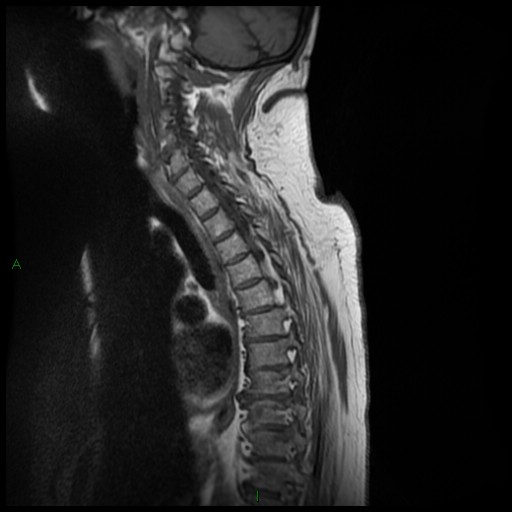
Slice 6 of 17
Can you make the diagnosis?
Review the images, then reveal
MRIMusculoskeletalConfirmedFRCR 2B
Traumatic cervical disc protrusion with cord compression
Clinical Presentation
Fall. Parapelgia.
- 1Normal craniocervical junction.C5/6- Large disc prolapse at C5/C6
- 2This combined with posterior longitudinal ligament calcification is severely compressing and distorting the cord, with both high signal and expansion of the cord at the C5/C6 level, consistent with the cord compression with cord oedema opposite the C5 and C6 vertebral bodies
- 3Minimal calcification within the prolapsed disc suggesting a large component of this is acute.Bilateral foraminal stenosis also at C5/C6 due to neurocentral osteophytosis.Small left paracentral disc osteophyte complex at T6-T7
- 4No cord compression or nerve root impingement.Left paracentral disc osteophyte complex at T10/T11 contacting the ventral aspect of the cord with mild exit foraminal narrowing
- 5No nerve root impingement.Diffuse disc osteophyte complex T11/T12 with left-sided asymmetry, contacting the ventral aspect of the cord
- 6No cord or nerve root impingement.